

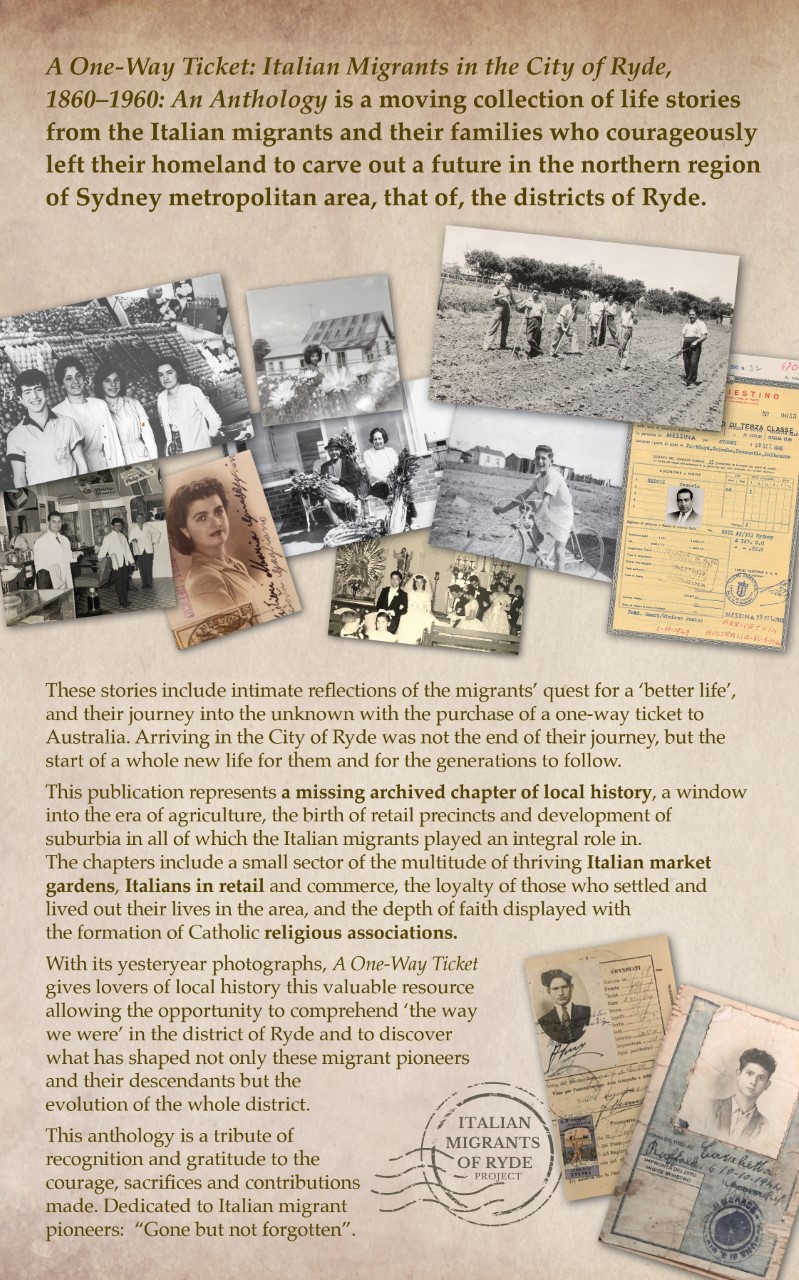
A One-Way Ticket: Italian Migrants in the City of Ryde 1860-1960 An Anthology curated and compiled by Angelina Bonifacio, edited by Anne Savage, Lady of Grace Fraternity, 2023. Left: Book cover. Right: Book rear cover. (Source: author)
The Italian Migrants of Ryde Project
Nadia Iacono
17 June 2025
Stories of migration and the locations where these are lived out in the everyday are fast disappearing in the wake of rapid development around the country. This can be particularly so where suitable arable land was once available for market gardening, poultry and agricultural pursuits before being rezoned for industrial, residential, education or transport.
While researching the history of a small local community shopping centre in Ryde, NSW, Angelina Bonifacio realised that little documentation existed reflecting more than a century of Italian settlement dating from the late nineteenth century.
This blog piece shares the story of how a determined Italo-Australian woman took on the challenge of recording a swiftly diminishing immigration history in Ryde. Angelina set out to document a community of everyday people that influenced the life and culture of the place with their distinctive lifeways. People and legacies that were no longer visible in the landscape or historical records of the area.
In reading Angelina’s research and understanding her journey to publication I wanted to show how histories can be recorded by everyday people who are not professionally trained historians or researchers. I interviewed Angelina to understand the steps that she took to succeed in publishing this contribution to Australian migrant research, her work was formally acknowledged with a Highly Commended NSW National Trust heritage award in 2024.
Angelina recognised that being part of the Italian community, and a fluent speaker of Italian, helped establish trust with the people she visited and interviewed for the book. Securing funding was the hardest part of the project. No surprise that it took community fundraising with lunches, dinners, movie nights, special events and bus tours. Local council and state grants were sought, though only one relatively small grant was awarded after several knockbacks.
The internet is replete with advice about writing and publishing local history. It also covers where to look for funding and how best to disseminate research. An important component that Angelina and others stress is to know how to interpret all your diligently collected material. It is not enough to write a timeline about the area’s known individuals, families and places. Angelina knew that a critical step lay in making sense of all the data was documenting how the community came to be, how the place and people changed and evolved over time and most significantly, how their presence as a community changed the local area.
Angelina’s best advice is to ‘Just Do It’. While getting started can seem daunting, once the stories were shared the project evolves and builds, with people mentioning other people and contacts being forged across community. Angelina also found that engaging a professional editor, while adding to the project cost significantly, improved the final publication, which is especially important for larger projects. Professionally edited publications are more likely to be purchased by professional institutions including universities and libraries.
For Angelina and those involved in the project, one of the most surprising and rewarding outcomes from publishing One Way Ticket was the number of books, articles and projects that it inspired others to pursue. It has become a valuable resource for historical societies and schools with a print run of 2,000 hard cover copies. Around 1,700 copies have been sold to date. It’s a substantial book at over 666 pages. Copies are held in the National Library of Australia, Australian National Maritime Museum, State Library of NSW and Ryde Library and available through the publisher.
More than just a place-based local history, the life stories in One Way Ticket attests to the value of the everyday as a source of community connection, continuity and belonging. Perhaps encouraging us all to share memories of everyday life. It reminds us that heritage isn’t only found in buildings, monuments, or museums, but in daily life and the habits we inherit, adapt, and share.
Reference
Angelina Bonifacio (2023). A One-Way Ticket: Italian Migrants in the City of Ryde 1860- 1960 an Anthology. Lady of Grace Fraternity.
Bio
Nadia Iacono is an archaeologist with over 30 years’ experience in archaeology and cultural heritage practice. She holds a PhD in Archaeology from La Trobe University, Victoria (2005) and is a GML Heritage Principal. Having worked in both the public and private heritage sectors Nadia has a detailed understanding of planning legislation, statutory compliance and best practice guidelines and their relevant applications in NSW. Her key areas of expertise include broad scale to site-specific archaeological and heritage assessment, management and strategic advice.

Hi Nadia,
Thank you, Thank you for this acknowledgment. If we can inspire and encourage others to also document a piece of history, and then learn from it, then we have achieved our goal.